
Review · WORKSHOPS
Taipei Calligraphy Workshop (DIY incl.)
Slow down with a brush in hand. This two-hour Taipei class turns Chinese calligraphy into a friendly, practical cultural lesson, not a distant museum display. You learn basic history and styles, practice brush control, and create pieces to take home.
I like the small group of six, which gives you room for personal guidance, and I like that total beginners can join without artistic training. The main drawback is the $79 price for a two-hour class, so it makes the most sense if you value instruction, cultural context, and a handmade souvenir.
I also appreciate the easy public-transport access and the calm tone described by past participants. Instructors named Teresa, Ginn, and Ruby have been praised for patience and clear teaching, though your instructor may vary.
In This Review
- Key points to know before booking
- What the Taipei calligraphy workshop is really like
- Starting with the long story of Chinese calligraphy
- Learning to hold the brush correctly
- From practice strokes to your own finished piece
- The teaching style and instructors
- A quiet room, tea, and a useful Taipei pause
- Is $79 a fair price for two hours?
- Who should book this class?
- Planning the meeting point and cancellation
- My verdict on this Da’an District experience
- FAQ
- How long does the Taipei Calligraphy Workshop last?
- What is the price?
- How many people can join the class?
- Do I need previous calligraphy experience?
- What will I learn during the workshop?
- Can I take my calligraphy home?
- Where does the class meet?
- Can I cancel for a full refund?
Key points to know before booking
- Six-person maximum: The small class size supports direct help with brush position, pressure, and stroke shape.
- A real hands-on lesson: You do not simply watch a demonstration. You handle the brush, practice techniques, and make finished work.
- Useful cultural context: The session covers the long development of Chinese calligraphy and different writing styles.
- A souvenir with personal meaning: Your final calligraphic pieces are created by you and taken home.
- A calm rainy-day activity: The workshop has been described as relaxing, with tea served during at least one session.
- Good for beginners: No previous calligraphy experience is required, and most people can participate.
What the Taipei calligraphy workshop is really like
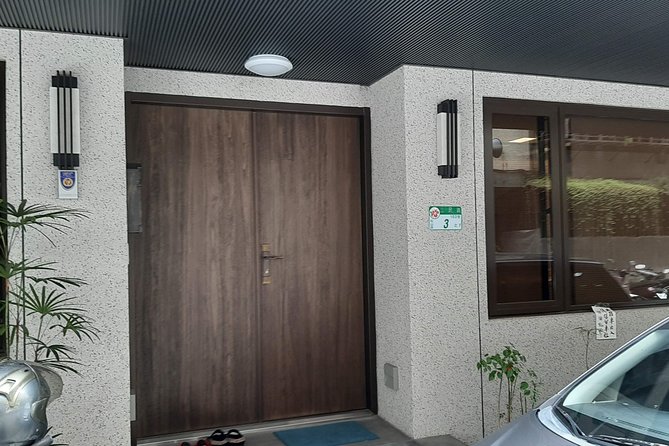
This is a compact cultural class in Taipei’s Da’an District, held at No. 16, Lane 151, Section 2, Jianguo South Road. You make your own way there, meet the instructor, and return to the same meeting point when the class ends.
The format matters. A six-person limit is small enough that you should not feel lost in a crowd or pushed through a standard demonstration. Calligraphy depends on small physical adjustments, such as how you hold the brush, how firmly you press, and when you lift your hand. A close instructor can spot those details quickly.
The class lasts about two hours. That gives you enough time for a short introduction, guided practice, and a final piece, without demanding a full day of your Taipei schedule. Still, one practical point is worth noting: if you become absorbed in the process, two hours may feel short. One participant wished the class had lasted longer.
More workshops and classes in Taipei:
- Xiao Long Bao, Beef Noodles & Boba Tea Cooking Class in Taipei
★ 5.0 · 159 reviews - Xiao Long Bao, Chicken vermicelli with mushroom and sesame oil, Tofu strips salad, Bubble milk tea. Taiwan Traditional Delicacies Experience-A (Taipei Cooking Class)
★ 5.0 · 79 reviews - Taipei Cooking Class & Market Adventure in Historic Dadaocheng
★ 5.0 · 77 reviews
Starting with the long story of Chinese calligraphy
The workshop begins with an introduction to Chinese calligraphy’s thousands of years of development. This is not just background decoration. Understanding how writing styles changed helps you look at calligraphy with more interest when you visit places such as Taipei’s National Palace Museum.
You learn about different styles before putting ink to paper. That order is useful because it gives your practice some context. Instead of copying an attractive character without knowing why it looks that way, you begin to see that brushwork, form, and style are connected.
The information appears to be pitched at beginners. You do not need to know Chinese, and one participant who already knew some Chinese still found the class expanded her understanding. That makes the workshop suitable for both first-time visitors and people who have already encountered Chinese characters.
Expect the historical portion to be an overview rather than an academic course. Two hours is enough for a lively introduction, not a complete study of calligraphy across every period and school. If your main goal is formal art training, this will likely feel introductory. If you want cultural context before or after a museum visit, it should fit nicely.
Learning to hold the brush correctly
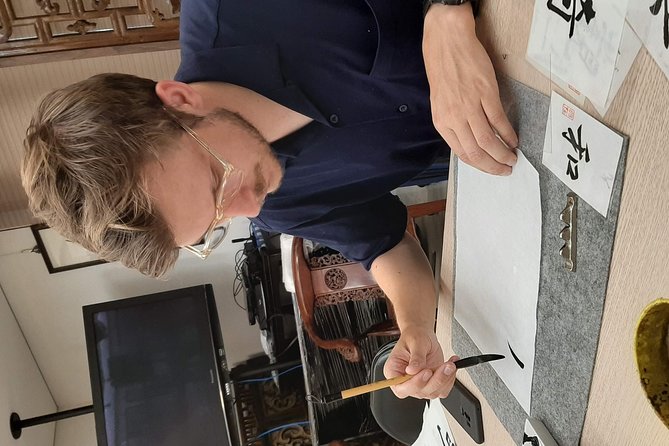
The first practical challenge is the brush itself. Many beginners assume calligraphy is simply writing Chinese characters slowly. It is closer to controlled brush painting, where the angle, pressure, speed, and lift of the brush all affect the mark.
The instructor shows you how to hold and manage the brush, then guides you through basic movements. The supplied description does not specify every exercise, so you should not expect a fixed list of characters or techniques. You can expect simple practice designed to help you become more intentional with each stroke.
That focus on presence is one of the class’s best features. The workshop presents calligraphy as a way to slow down and concentrate, not only as a method of producing attractive writing. You may find that the quiet repetition makes the session feel more like a creative pause than a conventional sightseeing stop.
This is also where the small group earns its keep. If your brush angle is awkward or your pressure is too heavy, direct advice can help you correct it before the final piece. The instructors have been praised for patience, especially with people who consider themselves not very artistic.
From practice strokes to your own finished piece
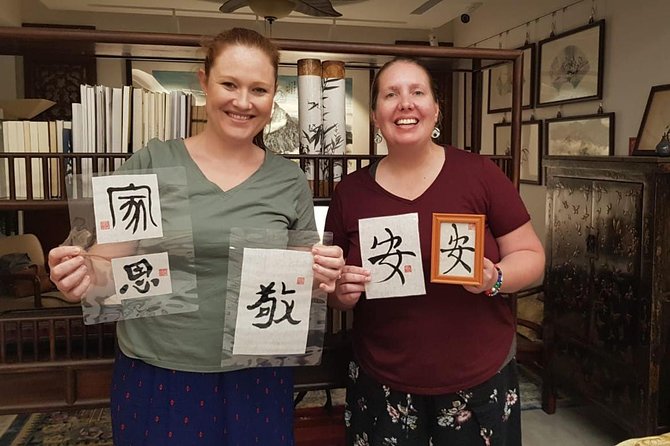
After learning the basic principles, you use them to make your own calligraphic work. The appeal is clear: you leave with something you produced during the class, rather than a factory-made souvenir bought in a shop.
Do not expect your first brushwork to look like a master’s scroll. That is not the point. The value comes from understanding how much control sits behind a finished character, then seeing your own attempts improve during the session.
You may create a small number of pieces rather than a large portfolio. The exact number is not stated, so it is best to think of the result as a personal mini masterpiece, not a full set of professional works. The finished sheets can be taken home, making them easy to pack and meaningful to display later.
This part also gives the lesson a clear payoff. You begin with history, move to technique, and finish by applying what you have learned. The sequence prevents the class from feeling like either a lecture or a casual craft activity.
More things to do in Taipei:
- From Taipei: Shifen, Jiufen, and Yehliu Guided Day Trip
★ 4.6 · 1,654 reviews - Full-Day Private Custom Taipei City Tour
★ 5.0 · 911 reviews - From Taipei: Yehliu, Jiufen, and Pingxi Day Tour
★ 4.7 · 892 reviews - Taipei: Jiufen Night View and Shifen Day Tour
★ 4.6 · 870 reviews
The teaching style and instructors
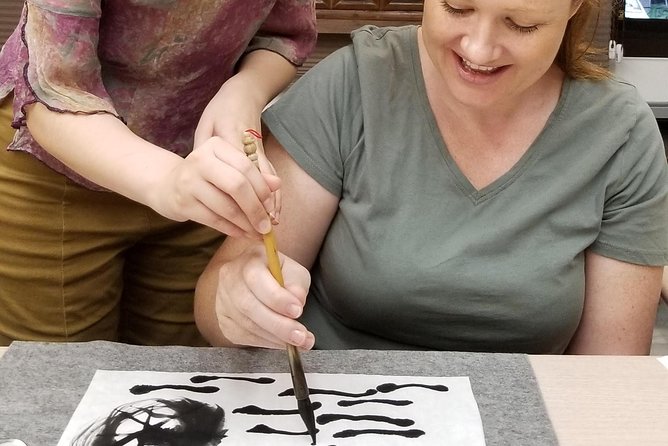
The strongest praise centers on the instructors. Ruby has been described as easy to communicate with before the class, which is useful when you are finding an unfamiliar address in Taipei. During the workshop, she was praised for being patient, informative, and clear.
Teresa has also received warm praise for her gentle manner and careful teaching. One session took place in a room filled with Chinese paintings, calligraphy, and artifacts, which added to the sense of place. Another participant appreciated Teresa’s ability to adjust the lesson to personal interests.
Ginn was praised for helping a participant who already knew some Chinese develop a broader understanding. That detail suggests the lesson does not have to remain purely mechanical. You can ask questions about the language, the art, or the cultural setting.
The names indicate that more than one instructor may lead the experience. Since your guide is not guaranteed by the supplied details, it is safest to expect the same beginner-friendly format rather than one specific teaching personality. The consistent themes are patience, warmth, and clear explanations.
A quiet room, tea, and a useful Taipei pause
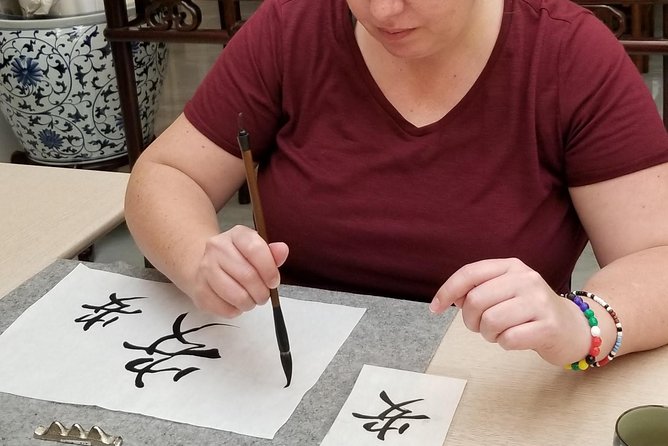
The setting has been described as attractive, with Chinese art and artifacts on display. That is an important part of the experience. Calligraphy feels different when you practice it in a room connected to the art rather than at a generic activity table.
Tea was served during at least one class and described as delicious. It is not listed as a guaranteed inclusion, so treat it as a pleasant possibility rather than a promised feature. The calm atmosphere may be especially welcome after a busy day in Taipei or during wet weather.
This is not a high-energy activity. You are not moving between major sights, taking photos at every turn, or racing through a schedule. The reward is concentration and conversation. I would pair it with a museum visit, a slow café stop, or another Da’an District activity rather than trying to squeeze it between several distant attractions.
Is $79 a fair price for two hours?
At $79 per person, this is not the cheapest creative activity in Taipei. You are paying for a small class, individual instruction, cultural explanation, materials, and finished work to take home. Gratuities are included, so there should not be an expected tip added to the stated cost.
The value depends on what you want. If you only want to try a brush for a few minutes, the price may feel high. If you want a structured introduction, a patient teacher, and a souvenir with a personal story, the cost is easier to justify.
The maximum of six is especially important in the price calculation. A larger class could offer a lower rate, but you would probably receive less correction and less time with the instructor. Here, the limited attendance supports a more personal lesson.
Group discounts are available, which may improve the value if you are booking with friends or family. The class also accepts mobile tickets, making the booking process convenient once your plans are set.
Who should book this class?
I would recommend it to first-time visitors who want more than passive sightseeing. You get a cultural explanation, a practical skill, and a keepsake in one short appointment.
It also suits people who are curious about Chinese characters but do not speak Chinese. You can appreciate the physical beauty and structure of the writing without needing language fluency. People with some Chinese knowledge may also find the style and historical discussion worthwhile.
The workshop works well for couples, friends, and small family groups. It offers a shared activity without requiring athletic ability or specialist training. Most people can participate, and service animals are allowed.
You may want to skip it if you dislike seated creative work, prefer a fast schedule, or expect a complete professional course. The class is designed as a welcoming introduction, not an advanced certification program. Its strength is accessibility and personal attention.
Planning the meeting point and cancellation
You must arrange your own transportation to the meeting point at No. 16, Lane 151, Section 2, Jianguo South Road, in Da’an District. Private transportation is not included, but the location is near public transportation and has been described as easy to reach.
Check the address carefully before leaving, especially if you are using a taxi or map app. One instructor helped with directions in advance, which is reassuring, but you should still allow enough time to find the classroom.
Confirmation is provided when you book. You can cancel for a full refund up to 24 hours before the local start time. Changes or cancellations inside that 24-hour window are not accepted for a refund. The class also requires a minimum number of participants, and if that minimum is not reached, you are offered another date, another experience, or a full refund.
My verdict on this Da’an District experience
Book the Taipei Calligraphy Workshop if you want a calm, personal cultural activity with a clear result at the end. The six-person limit, patient instruction, historical introduction, and handmade pieces give the class more substance than a quick tourist craft stop.
The $79 cost is the main question. I would pay it for a meaningful two-hour break, especially if you are traveling with a small group and can use the group discount. I would not choose it if your schedule is packed or if you want advanced calligraphy training.
For most first-time participants, the appeal is simple: you learn why the art matters, feel the brush respond under your hand, and leave with a piece that carries a memory of Taipei.
FAQ
How long does the Taipei Calligraphy Workshop last?
The workshop lasts approximately two hours.
What is the price?
The listed price is $79 per person. Group discounts are available.
How many people can join the class?
The activity has a maximum of six participants.
Do I need previous calligraphy experience?
No. The workshop is beginner-friendly, and no experience is needed.
What will I learn during the workshop?
You learn about the history and development of Chinese calligraphy, different writing styles, brush handling, and basic techniques.
Can I take my calligraphy home?
Yes. You create your own calligraphic pieces and can take them with you.
Where does the class meet?
The meeting point is No. 16, Lane 151, Section 2, Jianguo South Road, Da’an District, Taipei City, Taiwan 106. The activity ends at the same meeting point.
Can I cancel for a full refund?
Yes. You can cancel at least 24 hours before the experience start time for a full refund. Cancellations or changes made less than 24 hours before the start time are not accepted for a refund.
Just added in Taipei
- Taipei: 8 Hours Private Day Tour in Wulai with Benz Vito★ 4.4 · 5 reviews
- Vintage Taipei – Best of Taiwan and Sunset Walking Tour★ 5.0 · 4 reviews
- One Day Tour of Yilan, Zhang Mei Ama Farm★ 5.0 · 2 reviews
- Yilan Whale Watching and Animal Farm Private Tour from Taipei★ 5.0 · 1 review
- Yilan Rural Tea Picking Experience from Taipei City★ 5.0 · 1 review
- Yilan 1-Day Private Tour to Kavalan Whisky & Cultural Gems★ 4.5 · 3 reviews
- Yilan Kavalan Whisky Distillery,Jim&Dad’s Brewing, Shenkeng Tour★ 5.0 · 1 review
- Yangmingshan National Park & Hot Spring Tour (afternoon )★ 3.0 · 2 reviews
Workshops, compared.

Xiao Long Bao, Beef Noodles & Boba Tea Cooking Class in Taipei
Read our review →
Taipei Cooking Class & Market Adventure in Historic Dadaocheng
Read our review →
Xiao Long Bao & Boba Tea Cooking Class in Taipei
Read our review →
Xiao Long Bao, Pork thick soup, Bubble milk tea. Taiwan Traditional Light Meals Experience-B (Taipei Cooking Class)
Read our review →
Street Food Cooking Class in Taipei : Gua Bao/Lu Rou Fan/Boba Tea
Read our review →

Xiao long bao, Pork thick soup, Bubble milk tea. (Taiwan Cooking Class)-B
Read our review →Browse the lists this tour appears in